|
|
1984
Books by Title
1984
George Orwell is actually the
pseudonym of Eric Arthur Blair
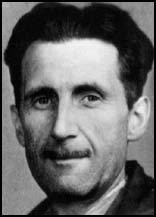
Born Eric Blair in Bengal, India, in 1903, George Orwell understood
English imperialism long before he began his career as a political critic
and journalist. As the son of an official in the Indian Civil Service,
Orwell spent his first eight years in India before his mother took him and
his sisters to be educated in England. Sent to an elite boarding school,
Orwell was one of few students allowed to attend at a lower tuition.
Orwell’s lower social class status made him the target of other students’
and school officials’ disdain and snobbery. However, Orwell completed his
early education successfully and was accepted to Eton on scholarship in
1917. At Eton, Orwell began to engage in political debate as he was
introduced to socialist ideas for the first time. However, Orwell decided
to join the Civil Service rather than attend university after he graduated
from Eton in 1921. As a member of the Civil Service, Orwell was sent to
Burma to serve in the Indian Imperial Police. Like his father, Orwell
became an embodiment of English imperialism. Although he often disapproved
of his own exercise of authority and power of the native Burmese, Orwell’s
experience in Burma helped him clarify his populist political beliefs. In
1927, while on leave, Orwell returned to England and resigned his post in
the Civil Service.
Orwell spent the next period of his life preceding the Spanish Civil War
living and working among the poor and working classes of London and Paris.
Orwell wrote novels (including Burmese Days and The Road to Wigan Pier),
contributed to numerous newspapers and publications, ran a bookstore, and
managed a pub with his wife. During this period, Orwell became a socialist
and assumed his pen name after an English river next to which he once
lived. When the Spanish Civil War erupted, Orwell joined the Republican
side was badly wounded. Upon returning to England, Orwell tried to join
the army but was rejected due to poor health. Instead, Orwell joined the
Home Guard and worked for the BBC during the Second World War. By this
time, Orwell’s anti-totalitarian, pro-socialist ideals had solidified and
had found a voice in the first of Orwell’s most famous novels, Animal
Farm, published in 1945. Four years later, Orwell published his second
“anti-utopian” epic, 1984, but he lived to enjoy his success only one
year. Orwell died in London from poor health in 1950.
Summary of 1984 by George Orwell
It appears to Winston Smith as though he is the only one still in his
right mind. Everyone else, it seems, cannot remember even trivial things
that happened only moments earlier. 1984 by George Orwell is the story of
Winston’s struggle to control his own life -- without letting anyone else
know that Big Brother isn’t controlling him. In London in 1984, the world
is run by three superpowers, Oceania, Euro-Asia, and East Asia, all three
constantly at war. 1984 is the story of live as controlled by a
totalitarian government, where no one has control of anything – especially
him- or herself. Big Brother is always watching, whether it be through the
telescreens present in nearly every room, your neighbor, your neighbor’s
children. Everyone can be betrayed by anyone at anytime, even if only
their facial expressions give the slightest hint that they are thinking
something they shouldn’t be thinking. Everyone lives in constant fear of
the thought police. The though police can arrest anyone at anytime, but
usually at night.
One day, Winston buys a diary from a small shop outside of the Party
district. He then begins to write in it, and what he writes is quite
shocking even to himself. “Down with Big Brother. Down with Big Brother.
Down with Big Brother. Down with Big Brother.” It is this writing in his
diary that sets Winston Smith on the journey of his life.
Winston is so fascinated by his betraying thoughts that he goes for a walk
and finds himself standing in front of the little shop where he bought the
diary. He buys a glass paperweight this time with a piece of coral inside.
But, also while he is there the proprietor shows Winston around the shop.
Upstairs there is a little room that used to be an apartment. Winston has
the fleeting thought of renting the room as a way of hiding from the
ever-present telescreen. The idea quickly leaves him, and he quickly
leaves the store.
However, Winston fails to look to see if any party member (recognizable by
their blue overalls) is in the street before going out (as he may then be
subject to extensive questioning and turned over to the thought police).
Outside he sees a girl he knows from where he works, the Ministry of
Truth. It is the girl wearing the red chastity belt around her waist. He
is sure that she is a member of the thought police and ready to turn him
in. He considers bashing in her skull with the paperweight in his pocket.
But he doesn’t.
On his way back home from the little shop, a rocket bomb explodes not far
from where he is walking. And as it does, he thinks briefly of the Party’s
slogans: War is Peace, Freedom is Slavery, and __________________. He
works in the Ministry of Truth, which is really the ministry of lies
(turning what is truth into lies so that the Party always appears to be
right). Winston’s job is to change what didn’t happen into what did
happen. For example, when Oceania is at war with Euro-Asia, Oceania has
always been at war with Euro-Asia and East-Asia has always been the ally.
And when Oceania is at war with East-Asia, then Oceania has always been at
war with East-Asia, and Euro-Asia has always been the ally. Therefore, any
article that exists stating that Oceania is at war with Euro-Asia, when it
is really at war with East-Asia must be changed, and the original
destroyed forever.
But it is not Euro-Asia nor East-Asia who is the greatest threat to
Oceania and Big Brother, it is William Goldstein, leader of the rebels.
As Winston is at work one day, he sees the girl in the red belt again. She
falls, hurting her arm, and he goes to help her. As he pulls her to her
feet again, she slips a piece of paper into his hand that reads, “I love
you”. Winston is no longer afraid that she is a member of the thought
police. Instead the two arrange a meeting. Finding a way to meet without
being seen is difficult. In the world of Big Brother, love does not exist,
and two people are only allowed to marry for the procreation of children.
If love is suspected between the two, the marriage cannot happen, and it
is quite possible that the two are killed by the thought police. The two
do manage to finally meet in a clearing far away from any hidden
microphones or telescreens. At first, Winston does not return the love of
the girl with the red sash, Julia. But he does love her after a time. The
age difference is hard for Winston in the beginning, thinking that she
cannot really love a man of 39 when she is only in her mid twenties. But
the two do fall in love and eventually turn the room over the little shop
into their hiding place and meet there regularly.
After many discussions Winston and Julia decide to join forces with
Goldstein and fight against Big Brother. They arrange to meet with O’Brien
who can set them up with ways to fight against Big Brother, but first they
must read the book written by Goldstein explaining all the problems with
living under the thumb of big brother. The Book also explains why the
party must always be right, why Oceania is constantly at war, and many
other things. The only problem Winston notices is that the book doesn’t
really tell him anything he didn’t already know.
One day while he and Julia are in the little room above the shop and
reading the book, he and Julia are arrested and carried away by the
thought police. It turns out that the little man who owned the shop was
really a member of the thought police, and there was a telescreen hidden
behind one of the pictures on the way. Winston and Julia are carried away
to the Ministry of Love.
Inside the Ministry of Love there are no windows, and the electric lights
are never turned off. It is inside the Ministry of Love where everyone is
broken. Everyone confesses (to everything, even things they didn’t do).
Everyone confesses anything they are asked to confess. Men are broken,
starved, tortured, beaten. Everyone is forced into betraying everything
and everyone. But will Winston betray Julia? Will Winston be turned and in
the end love Big Brother instead of hating him? Read the book to find out.
Review of 1984 by George Orwell
I read this book by myself, not for any class, just for fun. And I would
definitely recommend reading 1984, but not by yourself. George Orwell’s
1984 is absolutely a discussion book. You need to talk about this book as
you’re reading it with other people who are reading it at the same time.
1984 is a book that presents ideas that need to be talked about by many
different people who have varying opinions and conclusions. 1984 is not a
book to be read for fun – unless you are reading it with a group of
people. 1984 is not a book to be read by yourself. 1984 is a book that
everyone should read, however. 1984 discusses topics that most people
living in today’s societies wouldn’t think of. George Orwell presents
ideas that are not very far off from reality, but yet seem completely
inconceivable as truth. If you are discussing 1984 with a group of people
as you are reading it, the book becomes far more enjoyable. Especially if
you enjoy a little lively conversation that can quickly turn to debate. I
think you should definitely read 1984 by George Orwell, and think about
it. Thinking about the ideas presented by George Orwell is what makes this
book enjoyable. And the best way to think about totalitarianism is to
discuss it with a group of people.
|
|
